Donnie Iris, Pittsburgh’s rock legend who scored hits with ‘Ah! Leah!’ and ‘The Rapper,’ dies at 83
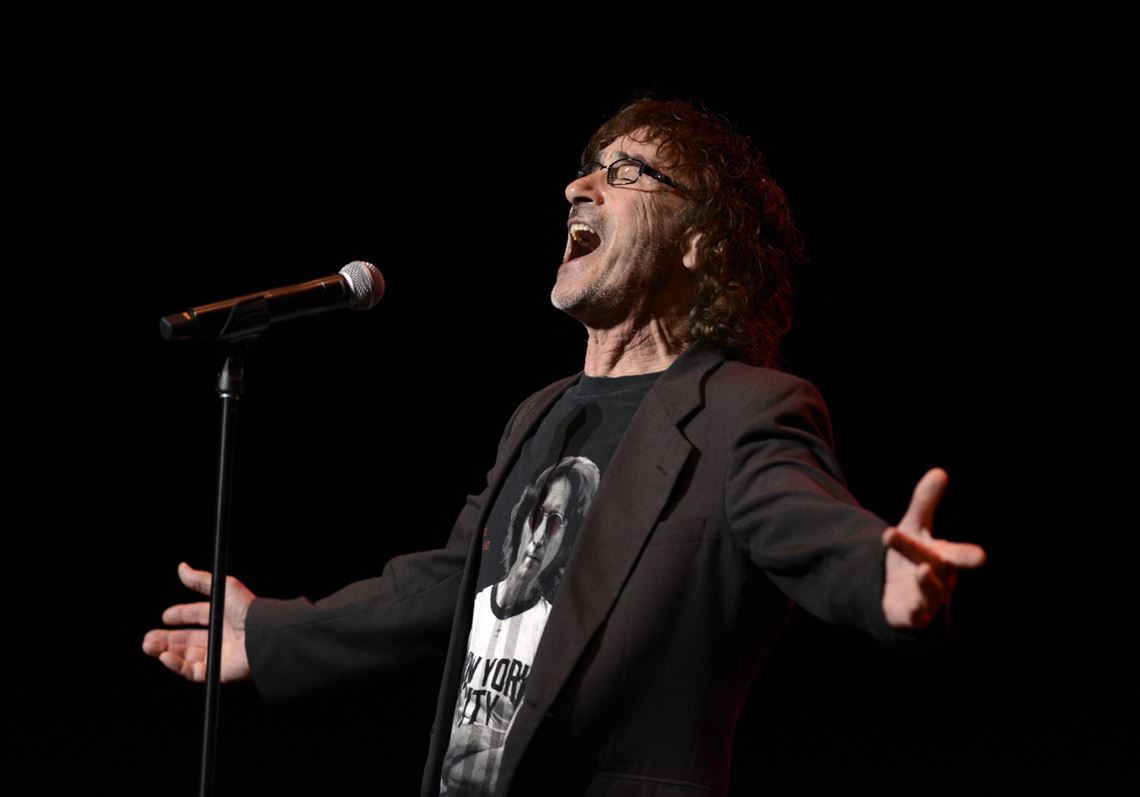
There aren’t many Pittsburgh legends known with just one name. Say “Donnie,” or, rather, “Dahnie,” in these parts and everyone knows exactly who you’re talking about.
Donnie Iris has been a legend in Western Pennsylvania going all the way back to the late ’60s as a member of The Jaggerz.
Iris, whose soaring vocals powered the hits “Ah! Leah!,” “Love Is Like a Rock” and “My Girl,” died Monday, according to friends and bandmates, after battling bladder cancer for three years. He was 83.
“For my money, he was the most beloved Pittsburgh musician of all time,” his colleague Joe Grushecky said. “I don’t know anyone who was loved more than Donnie. He just had that warmth about him, and it came through in his performance.”
Born Dominic Ierace in New Castle and raised in Ellwood City, Iris grew up on a steady diet of Frank Sinatra, Tony Bennett, Elvis Presley and, eventually, the Beatles, Rolling Stones and Motown.
His mother, who played piano in church, introduced him to singing at an early age.
“I started off really young,” he recalled in a 2018 interview. “I was only like 6 or 7 years old. My mother taught me how to sing when I was real little. We had a piano in the house, and she wanted me to sing. I probably would have rather gone out to play with the kids, but she wanted me to sing.”
He began his musical pursuits in high school, around 1961, with the doo-wop group the Fabutons. At Slippery Rock State College (now Slippery Rock University), he returned to the guitar and began playing rock ’n’ roll and R&B covers with the Tri-Vels and Donnie and the Donnells.
In 1964, as the British Invasion swept the country, he and Benny Faiella formed the Jaggerz, a group that became a staple of the Beaver Falls club scene, playing Motown and British Invasion covers six nights a week.
“I remember seeing him in the Jaggerz,” Grushecky said, “when they were basically doing Motown covers, and I thought they were the best local band I’d ever seen at the time.”
The band attracted the attention of the Shondells, who tried to lure Iris away before the Jaggerz had scored their first hit.
“I thought we had a pretty good group,” Iris said.
After signing with Gamble Records, founded by future Philadelphia soul pioneers Kenny Gamble and Leon Huff, the Jaggerz released “Introducing the Jaggerz,” in 1969.
The following year, they broke nationally with “The Rapper,” a catchy, soulful pop song written by Iris about the smooth-talking men he observed pursuing women in clubs.
“That was just from playing clubs,” said Iris in 2018. “I noticed a lot of guys at the bar would go up to chicks and start rapping to them. It was another way of saying hitting on a girl, not what rap means nowadays.”
The song reached No. 2 on the Billboard Hot 100, making the Jaggerz one of the biggest Pittsburgh-area success stories of the era.
The band never again matched that, and Iris eventually moved on to perform with another powerful regional singer, B.E. Taylor.
In 1978, while working part time as an engineer at Jeree Recording in New Brighton, Iris was recruited as a guitarist and background singer for Wild Cherry, two years after that Pittsburgh band's chart-topping “Play That Funky Music.”
The association didn't produce another hit for Wild Cherry, but it introduced Iris to Cleveland-based keyboardist Mark Avsec.
Avsec worked with him right up until the last show, with Iris playing the first concert at the new Citizens Live at the Wylie in the Hill District, on Sept. 28.
“He was my best friend. I was his best friend,” Avsec said. “It was a very symbiotic relationship. He was the most ordinary guy you ever met. The air was lighter when he was in the room. The mood was brighter when he was in the room. I tend to be on the other side. Together, we had this wonderful career. We went through challenges together, and we remained really close friends.”
The two bonded after rooming together on the road with Wild Cherry and began talking about making their own music.
“The album was a stiff. It came out terrible,” Iris said of Wild Cherry's attempt to record with legendary Muscle Shoals producer Rick Hall. “But in the meantime, Mark and I had roomed together in the band and decided we were going to try something on our own.”
They returned to Jeree and began assembling the songs that would become “Back on the Streets,” recruiting guitarist Marty Lee Hoenes, bassist Albritton McClain and drummer Kevin Valentine.
Together, the five musicians became Donnie Iris and the Cruisers.
They were nearly called the Turnpike Cruisers, inspired by the trips between Pittsburgh and Cleveland and Iris' fondness for the 1958 Mercury Turnpike Cruiser.
One of their first songs began with a wordless vocal hook, a chant that needed lyrics.
Iris knew a woman named Leah.
“We started out with just the hook, not even realizing it was a name,” he said. “We just wanted some sort of a chant vocal going on in the song. I said, ‘I know this girl named Leah. Why don't we just make the song about her?’”
The recording became a showcase for Iris' extraordinary voice, with vocal parts stacked as many as 60 times per note.
Released in 1980, “Ah! Leah!” began attracting radio attention on Cleveland's WMMS and Pittsburgh's WDVE before MCA Records picked it up for national distribution.
It reached No. 29 on the Billboard Hot 100 and introduced the country to a singer who looked more like Elvis Costello than Robert Plant — but could summon a scream that rivaled just about anybody in rock.
Pittsburgh and Cleveland embraced the Cruisers immediately.
“When we first came out with ‘Leah,’ we had a get-together at the Granati house,” Iris recalled. “Jimmy [Roach] and Steve [Hansen], who were the jocks at 'DVE, were there, and we played it for them. It wasn't long after that that they put it on the radio, and the song just took off. Pittsburgh and Cleveland were the first towns that embraced the stuff.”
“I had him at The Stanley many times on New Year’s Eve,” said longtime Pittsburgh concert promoter Rich Engler, who first met Iris in the late ’60s when his own band, the Grains of Sand, was sharing a rotation with the Jaggerz at a club called the Cove.
“One time it was Donnie Iris with special guest Bon Jovi. He got a real charge out of it — it was epic.”
The band's follow-up album, “King Cool,” released in August 1981, produced two more Top 40 hits with the guitar-driven “Love Is Like a Rock,” which reached No. 37, and the synthesizer-powered “My Girl.”
The album title came from a Toronto concert review that dubbed Iris the “new king of cool.”
With their muscular power pop, prominent synthesizers and an unlikely frontman in oversized glasses, the Cruisers found themselves on the fringes of New Wave, although Iris said much of his inspiration still came from the music of the 1950s and early ’60s.
His greatest vocal influence was Marvin Gaye.
“Just everything about him,” Iris said. “His voice, his songs. He had that kind of scream to his voice. That's basically where I realized I could do some of that.”
The Cruisers toured with Hall & Oates, the Romantics, Loverboy, Ted Nugent and Nazareth, playing arenas and outdoor festivals across the country.
Not every audience was prepared for them.
At a concert opening for Nazareth in St. Louis, Iris recalled walking onstage to find what looked like a sea of camouflage.
“They hated us,” he said. “They booed us from the time we hit the stage, until we got to ‘Leah.’ Then they knew who we were and started getting into it.”
The Cruisers' next two MCA albums, “The High and the Mighty” in 1982 and “Fortune 410” in 1983, failed to sustain the momentum. Only “Tough World,” which reached No. 57, and “Do You Compute?” at No. 64, cracked the Hot 100.
The band's fortunes were further complicated by a lawsuit from a Detroit songwriter who claimed “Ah! Leah!” had been taken from a song he had submitted to MCA.
The Cruisers prevailed, but the legal battle dragged on for years, consuming time, money and energy, while Iris was unable to release new music.
“That lawsuit over ‘Leah’ really set us back,” Iris said. “It took so much energy to go to court. It had an effect on us.”
The case had one unusual consequence: It inspired Avsec to become a copyright lawyer.
Iris, meanwhile, sought more stable financial ground in the mortgage business, eventually owning SimCorp in Aliquippa.
Some customers came to the office just to see the rock star.
“Some did,” he said with a laugh. “It got me some business I normally wouldn't have.”
Dropped by MCA in 1984, the Cruisers continued recording, releasing “No Muss ... No Fuss” in 1985 and four albums in the 1990s for a devoted fan base that never lost interest.
Later releases included “Ellwood City” in 2006 and the holiday album “Ah! Leluiah!” in 2010.
Although the national hits stopped coming, Iris remained a fixture on Pittsburgh radio and concert stages, where fans continued to turn out for the annual birthday celebrations and sing along with songs that had become part of the region's rock ’n’ roll identity.
His remarkable vocal range endured into his 80s.
“I’m lucky. One of the lucky ones,” he said in 2018. “I guess it’s just genes. I don’t hit some of those notes the way I used to, but my voice is still strong.”
He admitted that “That's the Way Love Ought to Be,” with its relentless high notes, had become more challenging than “Ah! Leah!” or “The Rapper.”
In a 2004 interview, when he was 61, Iris was asked if he expected to still be performing at 70.
“I don't think so, man,” he said. “But who the hell knows what's gonna happen?”
As it turned out, 70 was just another milestone.
In March 2023, Iris celebrated his 80th birthday with a sold-out concert at the UPMC Events Center in Moon, still summoning that famous scream.
Soon afterward, he underwent surgery following a cancer diagnosis and stepped away from the stage to recover.
By early 2024, he was back performing with the Cruisers, and the birthday shows continued.
For what would be his final show, opening at Citizens Live at the Wylie, Iris performed while sitting in a chair. He pulled it off well, despite saying he’d had a radiation treatment that afternoon.
“He sang like a bird that night,” Avsec said. “It was the first time on a chair, and he didn’t like that. But the poor guy, the cancer was spreading, and he was in pain, and he really wanted to do that show and be with the people.”
“It probably was the best thing for him to play one last time,” Engler said.
He announced his retirement nearly two weeks later.
For all his accomplishments, Iris remained a modest, unassuming star who seemed genuinely puzzled by the attention.
When Cleveland writer D.X. Ferris published “The Story of Donnie Iris and The Cruisers” to coincide with his 75th birthday in 2018, Iris confessed that he hadn't read it.
“No, hell no,” he said. “I already know what's in it!”
He hadn't even wanted a biography.
“I mean, who cares?” he said. “D.X. Ferris approached us about the book, and, for like two years, we said ‘no.’”
He eventually relented, figuring fans might want to know the band's history.
“He was so funny and had such a great laugh,” recalled Jim Krenn, a former WDVE morning man who, in 1988, began doing a skit with Iris called Pants ’N At. In it, the singer jokingly played his more successful fictional brother, Lonnie.
“I was so fortunate to become friends with him. He was a guy I admired and idolized, and to find out what a great man he was, was even sweeter,” Krenn said.
“He was just one of those people I was just blessed to know.”
In semi-retirement, he enjoyed playing golf and spending time with his two children and five grandchildren, one of them named Lia.
Joe Signore, one of his friends and neighbors in Beaver County, said, “We had a group of guys who were golf buddies — about 15 or 16 of us. He was just one the boys. Whenever we put a text out ‘Who wants to golf?’ he was the first one to say ‘I’m in.’ ”
Signore said Iris “shot his age,” scoring a 77 back in 2020.
“He was just a solid person,” Signore said. “No matter where we went, he was cordial with everyone. Everywhere we went, people wanted his autograph and he had time for everyone. Such a good man.”
Asked why he continued performing long after he once imagined he would retire, Iris pointed to the people who had followed him from the Jaggerz to the Cruisers and beyond.
“I guess the fans grow up with us, and sometimes they bring their kids,” he said. “So we keep going because they keep coming.”
“He’s going to be surely missed — big time,” Engler said. “He was an icon along with the Joe Grusheckys. He had national hits. Not too many people can say that coming out of Pittsburgh.”
“All I can say is it’s a sad day,” said former WYDD DJ Larry Gerson. “I had a bad feeling watching Donnie sing from a chair. The man was a local legend!”
Scott Mervis ( [email protected] ), a freelance writer based in Squirrel Hill, has covered the Pittsburgh music scene for more than four decades.
First Published: October 27, 2026, 6:21 a.m. Updated: October 27, 2026, 6:38 a.m.